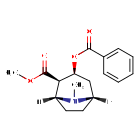
Cocaine is an ester local anesthetic used during diagnostic procedures and surgeries in or through the nasal cavities. An alkaloid ester extracted from the leaves of plants including coca.
- Mechanism
- Curator reviewed
Cocaine produces anesthesia by inhibiting excitation of nerve endings or by blocking conduction in peripheral nerves. This is achieved by reversibly binding to and inactivating sodium channels. Sodium influx through these channels is necessary for the depolarization of nerve cell membranes and subsequent propagation of impulses along the course of the nerve. Cocaine is the only local anesthetic with vasoconstrictive properties. This is a result of its blockade of norepinephrine reuptake in the autonomic nervous system. Cocaine binds differentially to the dopamine, serotonin, and norepinephrine transport proteins and directly prevents the re-uptake of dopamine, serotonin, and norepinephrine into pre-synaptic neurons. Its effect on dopamine levels is most responsible for the addictive property of cocaine.
- Primary indication
- For the introduction of local (topical) anesthesia of accessible mucous membranes of the oral, laryngeal and nasal cavities.Curator reviewed · 2 structured indications
- Formula / weight
- C17H21NO4 · 303.3529 g/mol (avg)
- First approval
- Canada, 2005 · United States, 2018
- Also known as
- Benzoylmethylecgonine · beta-Cocain · Cocain · Kokain · L-Cocain
- Code names
- IDS-NC-004 · RX-0041
- Brand names
Resolves to
ZPUCINDJVBIVPJ-LJISPDSOSA-NSMILES[H][C@]12CC[C@]([H])([C@H]([C@H](C1)OC(=O)C1=CC=CC=C1)C(=O)OC)N2CWhat you can answer from here — as of September 23, 2026
Which drugs share a target with Cocaine, and which of those have an active Phase 3 trial?
Create a free account or log in to explore the full data card.
Create Account